
K2-18b discovery: Signs of potential alien life detected on distant exoplanet with earth-like ocean, how far is it from Earth

Scientists have discovered signs on a distant planet that suggest it could potentially host life beyond our solar system.
The planet, named K2-18b, orbits a red dwarf star in the Leo constellation, approximately 124 light-years away, around 7 trillion miles from Earth, but still a relative neighbour within the Milky Way galaxy. K2-18b is roughly twice the size of Earth and was first discovered in 2015 by NASA’s Kepler mission.
A team led by researchers at Cambridge University made the breakthrough by re-analysing data collected by NASA’s James Webb Space Telescope (JWST). Their findings, published in the Astrophysical Journal Letters, revealed chemical fingerprints in the planet’s atmosphere that are similar to those produced by life on Earth, such as algae, seaweed, and marine phytoplankton.
The molecule in question is dimethyl sulfide (DMS), a gas that, on Earth, is exclusively produced by biological processes. According to Cambridge University, the detection of DMS is “the strongest evidence yet that life may exist on a planet outside our solar system.”
Still, scientists are approaching the discovery with caution. “It is in no one’s interest to claim prematurely that we have detected life,” said Nikku Madhusudhan, an astrophysicist at Cambridge and lead author of the study. “We want to remain open and do more experiments and theoretical calculations.”
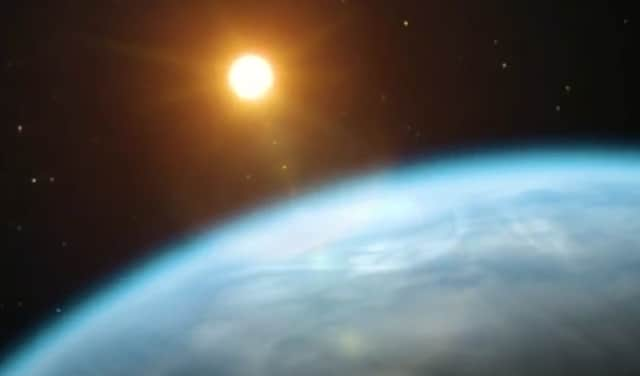

The latest research builds on findings from 2023, when Madhusudhan’s team detected carbon-based molecules in K2-18b’s atmosphere, raising the possibility that the planet might be a hycean world, a newly defined type of exoplanet that features a hydrogen-rich atmosphere and a liquid water ocean capable of supporting life.
“The only scenario that currently explains all the data obtained so far from JWST, including the past and present observations, is one where K2-18b is a hycean world teeming with life,” Madhusudhan said.
Despite this, he stressed there is still a 0.3% chance that the detection could be a statistical anomaly. “We need to be open and continue exploring other scenarios,” he added.
Jake Taylor, an astrophysicist and fellow at Oxford University, welcomed the findings but also urged caution. “I do not believe this is the biosignature detection that will revolutionise astronomy,” Taylor said.
He pointed out that molecules such as DMS and its close relative dimethyl disulfide (DMDS) could also be produced through non-biological processes, such as chemical reactions in comets.
Taylor also noted that re-analysing the telescope’s data and having an independent team verify the results would be key to strengthening confidence in the discovery. Despite the uncertainties, Madhusudhan said that even if the signals don’t confirm the existence of life, they still represent a major scientific milestone.
“However you put it, we are seeing new chemical processes on a planet that could be habitable,” he said. “This is, in my view, a transformational moment for finding our place in the universe as a species.”
K2-18b belongs to the “sub-Neptune” class of exoplanets, smaller than Neptune but larger than Earth, and is one of more than 5,000 exoplanets discovered since the 1990s. The search for life beyond Earth has long been considered the “holy grail” of exoplanet science.