
Volcano Iceland: 2024 eruption triggers evacuation of Blue Lagoon spa - flights and air travel disruption news


It’s unclear when the activity will end or what it means for one of Iceland’s most densely populated parts.
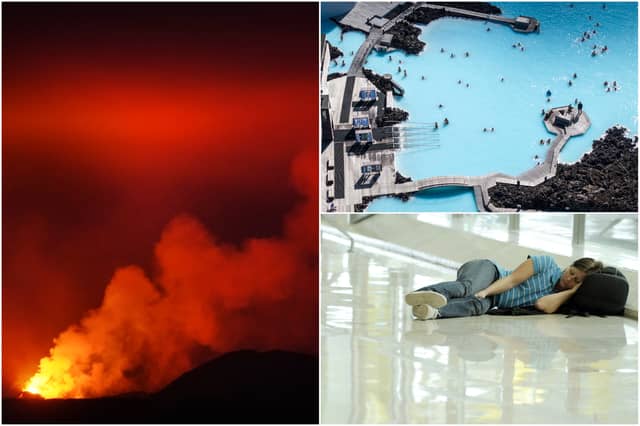
A volcano in southwestern Iceland has erupted, sending streams of red lava into the air and prompting the evacuation of the popular Blue Lagoon geothermal spa.
The eruption started in the early afternoon on 29 May after a series of earthquakes struck north of Grindavik, a coastal town with a population of 3,800, which was also evacuated.
According to the Met Office, lava was shooting approximately 50 metres (165 feet) into the sky from a fissure about one kilometre long. National broadcaster RUV reported that the Blue Lagoon thermal spa was evacuated before the eruption began.
The eruptions signal a reawakening of the Svartsengi volcanic system after almost 800 years of quiet. It is unclear when the period of activity will end or what it means for the Reykjanes Peninsula, one of the most densely populated parts of Iceland.
Iceland, which sits above a volcanic hot spot in the North Atlantic, sees regular eruptions and is highly experienced at dealing with them.
The most disruptive in recent times was the 2010 eruption of the Eyjafjallajokull volcano, which spewed huge clouds of ash into the atmosphere and led to widespread airspace closures over Europe.
But could the latest eruptions bring similar air travel disruption this time around? Here is everything you need to know.
Will the eruption affect travel?
It is currently unlikely that air travel will be disrupted by this eruption, as it is primarily producing lava rather than ash
Lava eruptions generally pose less of a threat to air travel than ash eruptions because lava does not produce the fine ash particles that can be carried into the atmosphere and disrupt flight operations.
The lava is also reaching heights of only around 50 metres (165 feet); relatively low compared to ash plumes that can reach several kilometres into the sky. The height of the eruption is a crucial factor because the higher the plume, the more likely it is to enter air traffic routes.
Any impact on air travel will also depend on wind patterns that could potentially carry ash (if produced) into flight paths. As of now, there is no significant ash production or adverse wind conditions.
Is it currently safe to travel?
Travellers are advised to avoid Grindavik and follow local restrictions. For the latest advice, visit the Icelandic Met Office and Safe Travel Iceland.
Otherwise, Iceland remains a safe destination. No countries have issued a travel warning against visiting, meaning airlines and holiday companies are operating as normal, and travellers who cancel their bookings have no automatic right to a refund.
Despite being just 20 kilometres (12 miles) north of the eruption site, Keflavik International Airport - Iceland’s main international airport - remains open with flights arriving and departing as scheduled.
The airport has advised passengers to "monitor flight information,” which you can do by clicking here. The airport also said it is accustomed to volcanic activity and is well-prepared to handle it without needing to close.
Can I still visit the Blue Lagoon?
The Blue Lagoon geothermal spa, one of Iceland’s biggest tourist attractions, was evacuated when the volcanic eruption began. The spa is still closed and will remain so until at least 31 May, according to the official website.
"Due to a volcanic eruption that commenced in Sundhnúksgígar on 29 May, we took the precautionary measure of evacuating and temporarily closing all of our operational units today,” the Blue Lagoon management said.
All customers with bookings will be contacted, and those wishing to change or cancel their booking can do so on the official website.
Why did the Eyjafjallajokull volcano cause such disruption?
The Eyjafjallajokull volcano eruption in 2010 caused significant disruption to air travel because it produced an extensive ash cloud containing fine, abrasive particles of volcanic ash.
These particles can be particularly hazardous to aircraft because they can damage engines, leading to engine failure, and impair visibility and instrument readings.
The ash plume reached up to 9 kilometres (30,000 feet) in height - within the cruising altitude range of commercial aircraft - and the wind patterns at the time carried the ash cloud over a large area of European airspace, one of the busiest air travel regions in the world.
At the time of the eruption, there was limited experience and protocols for handling such widespread volcanic ash clouds. The initial response was cautious, leading to extensive airspace closures while safety assessments were conducted.
The eruption also continued over several weeks, causing prolonged disruption, and the timing coincided with a period of high air traffic, exacerbating its impact.