
Van Gogh's The Starry Night may have hidden a secret in plain sight for 137 years
A remarkable discovery in the night sky could change what we know about one of the world's most famous paintings.
Vincent van Gogh's The Starry Night, with its swirling blue sky, brilliant stars and glowing moon, has fascinated art lovers for generations. But researchers now believe the painting itself could reveal exactly when the Dutch artist saw the scene that inspired it.

And the answer may rewrite a small but significant piece of art history.
The masterpiece, painted while Van Gogh was staying at a psychiatric hospital in Saint-Rémy, southern France, has traditionally been associated with June 1889.
That dating was based on a letter the artist wrote to his brother Theo around June 18. But there has always been a problem with the accepted timeline.
The moon in the painting simply doesn't match the moon that would have been visible at the time.
Now, a team of astronomers believes it has solved the mystery by identifying a particular arrangement of stars that appeared in the sky before dawn around July 22, 1889.
The researchers say the painting captures a waning crescent moon, the brilliant planet Venus and the Hyades star cluster in the constellation Taurus.
Crucially, all three would have been visible from Van Gogh's location at around the same time.
The findings, published in the scientific journal Scientific Reports, suggest the famous night sky may have been based much more closely on reality than previously believed.
The clue scientists spotted in Van Gogh's painting
The breakthrough came after researchers from South Korea questioned earlier attempts to identify the stars.
Previous studies in the 1980s had produced conflicting conclusions, while many art historians have interpreted the painting's dramatic sky primarily through symbolism and imagination.
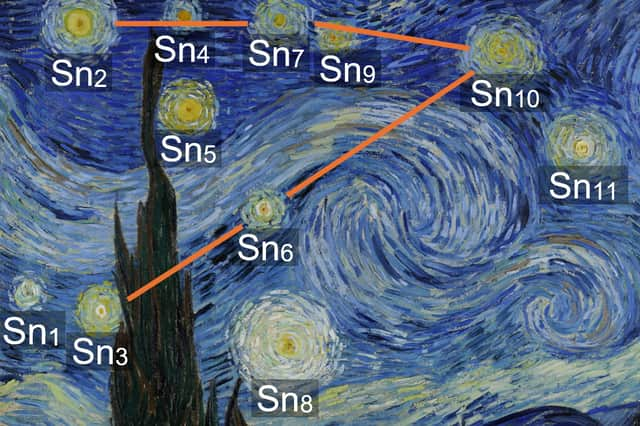
But researcher Elijah Jeong-hyun Kim, who has spent years building telescopes and observing the night sky, recognised a familiar pattern.
"To an observational astronomer, the cluster of stars in The Starry Night is the Hyades in Taurus," he said.
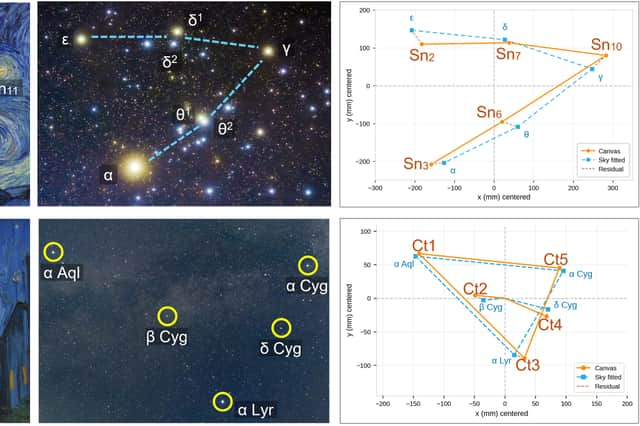
The team travelled to France to reconstruct Van Gogh's view and used a statistical technique to compare the positions of five stars in the painting with the real star cluster.
They found a close correspondence, with an even stronger match in a pen drawing Van Gogh produced afterwards.
The scientists also re-examined the artist's letters, historical weather records and references to cicadas to investigate whether the proposed July date fitted with his movements and periods of illness.
Their analysis challenges the long-standing assumption that Van Gogh was too unwell to have observed the sky at that point in the summer.
Could other Van Gogh masterpieces contain hidden clues?
The discovery could have implications beyond The Starry Night.
Using the same technique, the researchers suggest that the stars in Van Gogh's 1888 painting Café Terrace at Night may represent the Summer Triangle, a well-known pattern formed by three bright stars.
Kim, who is also chief executive of space-science company SLLAB, hopes the research will encourage a fresh examination of Van Gogh's paintings and working methods.
"Our conversation with Van Gogh's other skies is still ongoing," he said. "We plan to tell those stories one by one."
The findings do not definitively establish when Van Gogh completed The Starry Night, but they offer a striking possibility: that the answer to a 137-year-old mystery has been shining from the canvas all along.