
Mystery skeleton found in Roman coffin at Westminster Abbey may finally be identified

This article contains affiliate links. We may earn a small commission on items purchased through this article, but that does not affect our editorial judgement.
A skeleton discovered inside a Roman sarcophagus at Westminster Abbey more than 150 years ago may belong to a medieval abbot, with new research narrowing the search to two possible identities.
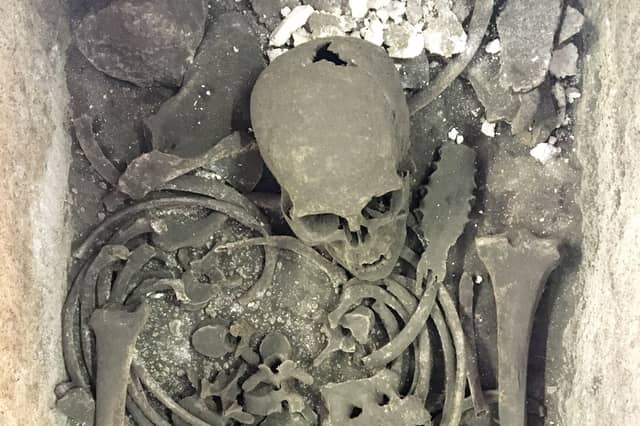
A mysterious skeleton discovered inside a Roman sarcophagus at Westminster Abbey more than 150 years ago may finally have been identified, with archaeologists believing it could belong to a senior medieval monk who died around 1,000 years ago.
The limestone coffin was inscribed with the name Valerius Amandinus, a wealthy Briton who lived in London during the 4th Century AD, when it was excavated at the Abbey in 1869.
However, a Latin cross carved into the lid, believed to date from the 10th or 11th Century, suggested the remains inside belonged to someone who died centuries after the sarcophagus was originally made.
The identity of the person buried inside has remained a mystery until now, following a fresh analysis by Professor Warwick Rodwell, consultant archaeologist at Westminster Abbey. His research, published in the Journal of the British Archaeological Association, suggests the most likely candidate is Aelfwig, a senior monk who died around 1020.
Prof Rodwell said Aelfwig served as an Abbot at Westminster Abbey before later taking up the same position at a Benedictine monastery. Another possible candidate is his successor, Wulnoth, who died in 1049 and is also believed to have been buried at the Abbey.
Prof Rodwell said: “We have two viable contenders for the occupant of the sarcophagus. We do not know the date of birth of either. But either would fit equally well if we assume the Abbot was in his early twenties when the appointment was made and close to 50 when he died. The fact Aelfwig was already a monk of Westminster might favour him.”
The archaeologist said the quality of the burial could provide another clue, suggesting the occupant was honoured with a “fine sarcophagus”. According to Prof Rodwell, a wooden coffin was placed inside the stone burial container, potentially representing an early example of recycling. The lid was then re-carved to feature a large Latin cross, adapting the Roman coffin for a medieval burial.
The skeleton and sarcophagus have been the subject of extensive research and debate over the years, with the latest findings offering new insights into their history. Channel 4's Time Team investigated the archaeology and structure of King Henry III's original sacristy, on the north side of Westminster Abbey, in 2009.
The sarcophagus had first been accidentally unearthed by workmen in 1820, when building work in the area resulted in its lid being smashed into six pieces. The Roman coffin was officially rediscovered during excavations in 1869, when the damage was repaired.
More recently, Pre-Construct Archaeology (PCA), one of Britain's largest commercial heritage practices, completed an excavation of the sacristy last year. The work was required ahead of the construction of the King Charles III Sacristy, which is due to open next year.
As part of the project, PCA human bone specialist James Young Langthorne examined the skeleton. His analysis suggested the deceased was a man aged between 35 and 49 who stood around 5ft 9ins tall.
That differs from an assessment carried out in the 19th Century, which described the remains as belonging to a “robust young man” measuring around 5ft 7ins and aged no more than 30. A bone sample was also sent to the Scottish Universities Environmental Research Centre for radiocarbon dating. The results indicated the man died between 987 and 1052 AD.
Prof Rodwell said: “This confirms that the reuse of the sarcophagus, and the associated remodelling of its cover, occurred in the late Saxon period.”
When the stone coffin was sent to a conservation studio in 2016, PCA researchers discovered an almost complete skeleton inside. They also identified the outline of a rectangular structure within the sarcophagus, marked by a white residue left behind by lime, a substance traditionally used in burials.
Prof Rodwell said: “Although no physical traces of that feature remained, it can only have been a timber coffin, which has completely decayed over the course of the seven centuries that the sarcophagus was buried in the sacristy courtyard.”
The Roman sarcophagus is now on public display in the Queen's Diamond Jubilee Galleries at Westminster Abbey.

🎤✨ Three nights away with live entertainment from £164? Parkdean’s Celebrity Weekenders bring the party this November! 🧳
🕺🎶 Relive your favourite decades with themed breaks spanning 80s hits, 90s nostalgia and boybands vs girlbands!
🏡🏊 Accommodation, entertainment and access to swimming facilities are included, with silent discos and fancy dress adding to the fun! 🎉
🌊⭐ Explore Parkdean’s Celebrity Weekenders across five parks, with prices and line-ups varying by break and availability 📅Click here to find out more

With the housing market continuing to shift in many parts of the UK, homeowners often choose to start by getting an up-to-date view of what their property could be worth. Estate agent Purplebricks offers a free, no-obligation valuation carried out by a local property expert familiar with current prices and demand in the area 📊.
The appointment typically includes an assessment of the property’s likely market value along with guidance on pricing and presentation if the owner decides to sell 💷. Valuations can be arranged online in just a few minutes by choosing a convenient appointment time and requesting a visit from a local property specialist.
👉 Book a free property valuation with Purplebricks here.