
What is Opec? UAE set to leave Organization of the Petroleum Exporting Countries amid Middle East war fuel crisis

The United Arab Emirates has confirmed its intention to leave Opec - what is the organisation and who is in it?
Following six decades of membership in the Opec group of oil producers, the United Arab Emirates has decided to leave. The news comes amid an energy supply shock in the Middle East spurred by the US-Israeli war with Iran.
Announcing its decision through the state-run WAM news agency, the UAE’s exit will be effective from Friday (May 1). A statement on the WAM news agency read: “This decision follows a comprehensive review of the UAE’s production policy and its current and future capacity and is based on our national interest and our commitment to contributing effectively to meeting the market’s pressing needs.
“While near-term volatility, including disruptions in the Arabian Gulf and the Strait of Hormuz, continues to affect supply dynamics, underlying trends point to sustained growth in global energy demand over the medium to long-term.”
The statement went on to say that the UAE would “continue to act responsibly, bringing additional production to market in a gradual and measured manner”. It is understood that the UAE has expressed frustrations with production quotas agreed by Opec members in a bid to control oil prices, with the decision also referring to a desire for greater flexibility.
The announcement comes as the war in the Middle East rumbles on with the closure of the Strait of Hormuz disrupting oil and gas supplies around the world, sending prices soaring.
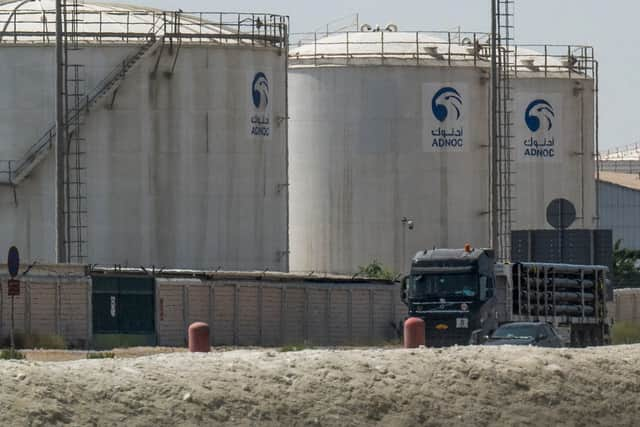

David Oxley, chief climate and commodities economist for Capital Economics, said the UAE had been “itching to pump more oil”. “The UAE’s desire to pump more oil has been placated up to now by a combination of the rest of Opec turning a blind eye to its overproduction and also raising its quota levels,” he said.
The economist suggested that, if energy flows get back to normal once the Strait of Hormuz reopens, then the UAE’s departure from Opec could “feasibly” result in it pumping an additional one million barrels per day – the equivalent of about 1% of global oil demand.
What is Opec?
Opec (Organisation of Petroleum Exporting Countries) was founded in Iran in 1960 and aims to co-ordinate production among member countries, stabilise oil markets and keep supply and income steady.
Their unified petroleum policies are in place to secure fair and stable prices for petroleum producers and an efficient, economic and regular supply of petroleum to consuming nations as well as a fair return on capital to those investing in the industry.
Opec member countries
The UAE joined Opec in 1967, and its departure will leave the oil cartel with 11 member countries. The remaining members are Algeria, Congo, Equatorial Guinea, Gabon, Iran, Iraq, Kuwait, Libya, Nigeria, Saudi Arabia, and Venezuela.
However, Mr Oxley warned UAE’s move could trigger other members to leave which would have bigger implications for the global oil market and prices.