
I've reviewed emergency radios – here's why this waterproof model is on my shortlist

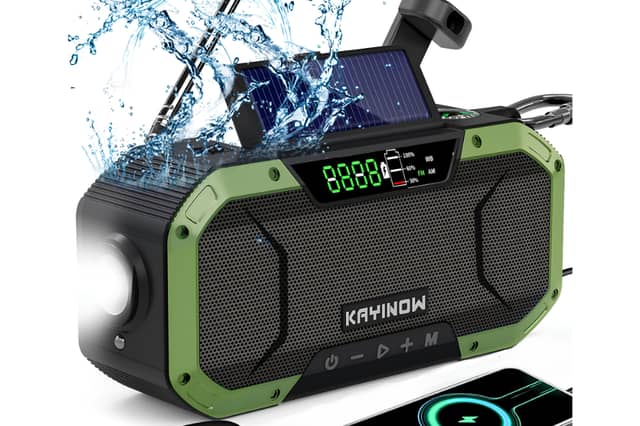

As households stock up on emergency supplies following new Government advice, I've found a wind-up radio with one feature that could make a real difference in a storm: IPX5 water resistance. And it has a few other useful tricks too.
Wind-up radios are enjoying a remarkable surge in popularity following new Government advice urging British households to prepare for three days without essential services. But while shoppers are snapping up emergency gadgets with torches, solar panels and phone chargers, there's one feature I think deserves rather more attention: waterproofing.
After all, some of the very emergencies we're being told to prepare for involve heavy rain, storms and flooding. And while keeping a radio in a dry kitchen drawer is all very well, what happens if you need to venture outside in terrible weather, or grab your emergency supplies in a hurry?
That's why the KAYINOW waterproof wind-up emergency radio has caught my attention. It combines the usual emergency features with an IPX5 water-resistance rating, meaning it's designed to withstand water jets and heavy splashes rather than needing to be protected from every drop of rain.
I've not tested this particular model, so I can't personally vouch for its reception, battery performance or durability. But having already tried other wind-up radios, the waterproof feature alone would be enough to put this one on my shortlist.
Browse our exclusive Amazon store
We’ve curated a custom list of products recommended by our expert writers, bringing together everything you need for your household emergencyb pack.
And when you look at everything else the manufacturer has packed into it, there's plenty worth investigating.
Why waterproofing could be the feature that really matters
The Government's new 'Be Ready' campaign encourages households to prepare for emergencies ranging from prolonged power cuts and cyber incidents to flooding and severe storms.
Among the recommended essentials are a battery-powered or wind-up FM radio, a torch, a charged power bank and enough food and water to cope for three days.
The thinking behind the radio recommendation is straightforward. If the electricity goes off, televisions and broadband routers stop working, and mobile networks may become unreliable.
A traditional FM radio offers an independent way to receive news and official updates, provided radio broadcasts remain available.

But there is a potential weakness with many inexpensive emergency radios: they're not necessarily designed to get wet.
That's where the KAYINOW emergency radio with IPX5 water resistance stands out.
The manufacturer says its casing uses ABS and TPU materials and is designed to withstand wet outdoor conditions, making it a potentially useful option for camping, hiking, storm preparation and emergency kits.
What does IPX5 waterproof actually mean?
Waterproof is one of those product descriptions that can mean very different things, so it's worth understanding exactly what KAYINOW is claiming.
An IPX5 rating indicates protection against water projected from a nozzle from different directions. In practical terms, that makes the radio suitable for exposure to splashes and rain within the limits of the rating.
It does not mean you can drop it into a flooded basement, leave it submerged in a puddle or expect it to survive being underwater.
That distinction matters, particularly when buying something for emergency use.
Nevertheless, a radio designed to cope with wet conditions has an obvious advantage if you're caught outdoors during a storm or need to move emergency supplies through heavy rain.
Personally, I think that's a more relevant feature than some of the extras being advertised on the growing number of inexpensive survival gadgets.
A 5,000mAh battery and three ways to recharge it
The KAYINOW wind-up radio has a built-in 5,000mAh rechargeable battery, giving it a reasonably substantial power reserve for a device of this size.
The manufacturer claims up to 35 hours of radio use from a full charge, although that's a figure I would want to verify through independent testing before relying on it during an emergency.
Charging is handled in three different ways.
There's a USB-C connection for normal charging, a small solar panel that can help replenish the battery in suitable sunlight and, crucially, a hand crank that allows you to generate some power manually.
The hand crank is the feature that makes a device like this particularly relevant to the Government's advice.
Even when the electricity supply is unavailable and your stored battery power has been exhausted, you still have a means of generating limited electricity to listen to radio broadcasts.
Solar charging is useful as an additional backup, although it's important to have realistic expectations. A small panel on a portable radio is unlikely to charge a large battery quickly, especially during a gloomy British winter.
I'd charge the radio fully before storing it in an emergency kit and treat the solar panel and hand crank as backup options rather than everyday charging methods.
It can charge your phone too
Another potentially useful feature is the ability to use the radio's internal battery as an emergency phone charger.
The KAYINOW has a USB output that allows you to transfer some of its stored power to a compatible smartphone.
That could be useful if a power cut lasts longer than expected and your phone is running low.
However, the 5,000mAh figure refers to the radio's internal battery capacity, not the amount of power guaranteed to reach your phone. Energy is lost during conversion and charging, so you shouldn't expect a full 5,000mAh of usable phone-charging capacity.
And there's an obvious trade-off: every bit of battery power you use to charge another device leaves less available for listening to the radio.
For that reason, I'd still keep a dedicated power bank in my emergency kit, exactly as the Government recommends.
What about the radio reception?
The KAYINOW is advertised as an AM/FM emergency radio with automatic station scanning and a retractable aerial.
It covers FM frequencies from 88 to 108MHz and AM frequencies from 520 to 1710kHz, meaning the FM band includes the stations British listeners would normally expect to receive.
The manufacturer also advertises a 7W speaker system, although advertised speaker wattage doesn't necessarily tell you much about actual sound quality or reception.
Without testing it, I can't judge how sensitive the tuner is, how well it handles weaker signals or how clear the speaker sounds.
Those are important considerations for any emergency radio because its primary job is to help you receive information.
One other detail worth mentioning is the NOAA weather-radio feature prominently advertised in the product's description.
NOAA weather radio is an American service and isn't the equivalent of a UK emergency broadcasting network. British buyers should regard the conventional FM and AM reception as the relevant radio functions rather than expecting the NOAA channels to provide UK weather warnings.
A built-in torch, reading lights and SOS alarm
Alongside its water-resistant casing and radio functions, the KAYINOW solar-powered emergency radio has several additional features that could be useful during a power cut.
There's a 3W LED flashlight for general illumination and a separate arrangement of four reading lights, which could help when cooking, reading instructions or moving around a dark room.
The manufacturer claims up to 180 hours of flashlight operation, although that figure will depend on how the light is used and remains unverified in my own testing.
There's also an SOS function, activated by holding down a button on the bottom of the radio.
This triggers an audible alarm and flashing red light, intended to attract attention if someone needs help.
Again, it's not something everyone will ever need, but an emergency alarm is a potentially useful additional function, particularly for people who spend time outdoors.
Is it practical enough for a household emergency kit?
At 16.5cm long, 7.6cm high and 4.6cm deep, the KAYINOW is compact enough to fit into a backpack or emergency grab bag without taking up too much space.
It weighs approximately 435g and comes with a carabiner, making it relatively easy to carry or attach to other equipment.
The green casing gives it the appearance of an outdoor survival gadget rather than a traditional portable radio, but the important features are fairly practical.
A single device that offers AM/FM reception, alternative charging methods, lighting, limited phone charging and some resistance to water could help households cover several items on the Government's emergency checklist.
That doesn't mean it replaces everything else, of course. I would still want a separate torch, a dedicated power bank and other basic supplies rather than depend entirely on one electronic device.
But the waterproofing adds a useful dimension that isn't always present in cheaper emergency radios.
How does it compare with the other wind-up radios I've looked at?
I've already tested the £29.99 Ryichi wind-up emergency radio, which impressed me with its combination of practical lighting features, charging options and straightforward AM/FM reception.
That model is now part of my own emergency grab bag, and I found it a useful addition to my household preparations.
I've also looked at the £59.99 Roberts R9957S, a much more traditional wind-up radio from a British manufacturer with a history stretching back to 1932.
The Roberts takes a simpler approach, concentrating on its core radio functions without adding solar charging, a phone charger or a large flashlight.
The KAYINOW sits in a different category, offering a wide range of features with the additional attraction of an advertised IPX5 water-resistance rating.
I wouldn't claim it's better than either model without testing it properly, but that extra protection against wet weather is certainly worth considering.
Would I buy the KAYINOW waterproof emergency radio?
Having already reviewed emergency radios and seen just how useful these relatively simple devices can be, there's one thing I'd look for when choosing another: a practical feature that genuinely adds something to the experience.
For the KAYINOW waterproof wind-up radio, that's its IPX5 water resistance.
A radio that can withstand splashes and rain makes obvious sense for emergency preparedness, particularly when severe weather and flooding are among the risks highlighted in the Government's guidance.
Its rechargeable 5,000mAh battery, solar charging, hand crank, torch, reading lights and emergency phone-charging function make it an interesting all-in-one package.
But there's a difference between an impressive list of specifications and a product that has been independently proven to deliver them.
I haven't tested the KAYINOW, so its real-world waterproofing, reception quality and battery endurance remain questions rather than established strengths.
Nevertheless, the combination of weather resistance and emergency functions means this is one I'd seriously consider for a future hands-on review.
With more households putting together emergency kits, it's a useful reminder that the best gadget isn't necessarily the one with the longest list of features. Sometimes it's the one with a particular feature that could make all the difference when conditions take a turn for the worse.