
Government emergency advice: £29.99 Amazon wind-up radio tested

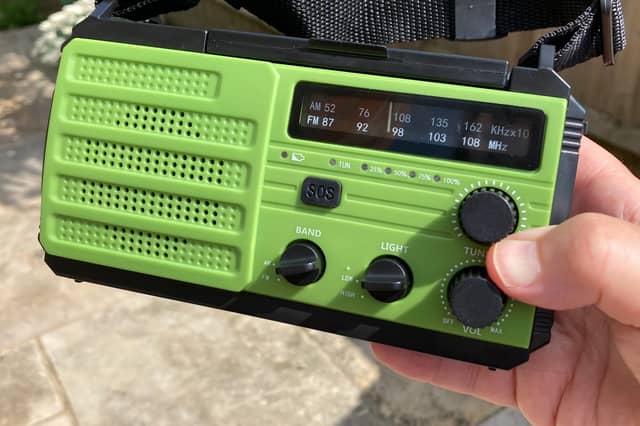

The Government's new emergency advice recommends keeping a wind-up radio and torch at home in case power, phone and internet services fail. I've tested a compact £29.99 Amazon gadget that combines both, along with several other useful emergency features.
The Government is encouraging households across Britain to prepare for at least three days of disruption to essential services, including electricity, water, mobile phones and the internet. And one of the items recommended in its emergency checklist is something many of us probably haven't owned for years – a wind-up radio.
The advice is part of the Government's wider emergency preparedness campaign, which encourages families to make simple preparations for everything from severe storms and flooding to prolonged power cuts. The aim is not to alarm people, but to ensure households can cope if everyday services suddenly stop working.
Among the essentials highlighted in the official guidance are bottled water, non-perishable food, torches, portable phone chargers and an FM radio that works without mains electricity.
That last recommendation caught my attention because I've already been testing a gadget that does several of those jobs in one. The Ryichi wind-up emergency radio is currently priced at £29.99 on Amazon, and after putting it through its paces, I've made it a permanent part of my own emergency grab bag.
Why the Government wants households to own a wind-up radio
It might seem an odd recommendation in an age when virtually everyone has a smartphone, but there's a good reason for including a traditional radio in emergency preparations.
During a significant power cut, home broadband routers stop working, mobile phone batteries eventually run flat and, in some circumstances, mobile networks can also lose service.
An FM radio powered by a battery or hand crank offers another way to receive news and official updates, provided local radio broadcasts remain available.
The Government also recommends writing down useful contact numbers and radio frequencies rather than relying entirely on information stored online when an emergency happens.
The Ryichi is particularly useful because it combines a radio with a torch, reading light, emergency alarm and a facility for providing backup power to a mobile phone.
What is the Ryichi emergency radio like to use?
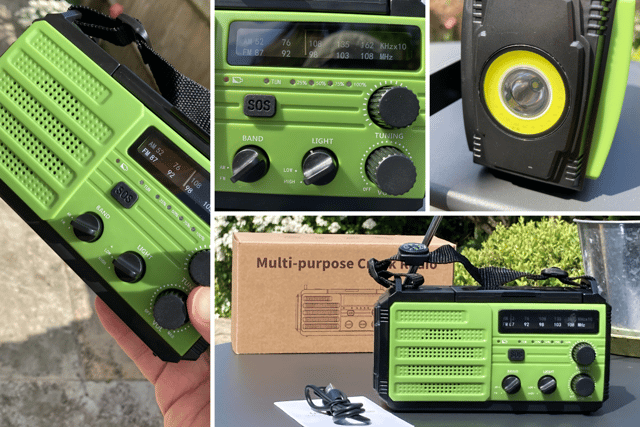
The first thing I noticed when unpacking the Ryichi was just how compact it is. It's small enough to fit inside a backpack, bedside drawer or car glovebox, but feels reassuringly sturdy rather than like a cheap novelty gadget.
The hand crank folds neatly into the body when not in use, while a supplied USB-C cable allows it to be charged from a normal power source before an emergency.
There are two USB functions. One is for charging the radio itself, while another allows you to provide some emergency power to a phone or other small device.
This is best regarded as a useful last-resort charging option rather than a replacement for a fully charged power bank, which is another sensible item to include in a household emergency kit.
The ports are tucked behind a rubber protective cover to help keep out dust and moisture, and there's also a headphone socket for private listening.
Does the radio actually work well?
Tuning is refreshingly straightforward, with a simple switch to select AM or FM and a traditional tuning control to find your station.
A green indicator illuminates when you've found a strong signal, and I was pleasantly surprised by the clarity of the sound from such a small speaker.
It's not going to compete with a dedicated Bluetooth speaker for music, but that's hardly the point. For listening to news bulletins during a blackout, it does the job perfectly well in my testing.
And because it doesn't depend on Wi-Fi or a mobile data connection, it's a useful fallback when more sophisticated technology lets you down.
The built-in lights are surprisingly useful
The lighting arrangement is one of my favourite features, particularly given that the Ryichi costs just £29.99.
Lift the solar panel and you'll find a reading light powered by six LEDs. There are three brightness settings, meaning you can illuminate a room, read instructions or simply conserve battery power.
There's also a front-facing spotlight with its own button and three brightness levels, effectively turning the radio into a handheld torch.
This is another useful feature in light of the Government's emergency guidance, which recommends torches rather than candles because of the fire risk.
For situations where you might need to attract attention, there's also a built-in SOS alarm. Holding down the button for three seconds triggers a loud siren accompanied by a flashing light.
Four different ways to keep it working
The radio's biggest advantage is that you aren't entirely dependent on a wall socket to keep it charged.
The normal USB-C connection is the easiest way to top up its battery, but the small solar panel can also provide some additional charging in suitable sunlight.
Then there's the hand crank, which is arguably the most reassuring feature. If the battery runs low during an extended outage, you can generate a little more power yourself.
According to the product's stated performance, one minute of cranking can deliver around ten minutes of light or six minutes of radio use, although actual results will vary depending on conditions and power consumption.
Four blue LEDs indicate the remaining battery level, while a red indicator shows when the unit is charging.
Solar and hand-crank charging are relatively slow, so I'd always recommend starting with a fully charged battery rather than relying on them to keep the radio running indefinitely.
Why a radio could be more useful than your smartphone
One of the lessons from major power outages overseas, including the widespread blackout affecting Spain and Portugal in 2025, is just how quickly modern communications can become unreliable when electricity supplies are interrupted.
Even where mobile phones retain some battery charge, network disruption can make it difficult to access information.
A traditional radio isn't immune to every possible disruption, but it adds an independent way to receive information, which is precisely why it appears in the Government's household emergency checklist.
And unlike many specialist emergency supplies, it's something you can use at any time, whether that's listening to the radio in the garden, taking it camping or keeping it handy during winter storms.
Is the Ryichi worth buying at £29.99?
Having tested it thoroughly, I think the Ryichi makes a sensible addition to a household emergency kit, particularly at its current £29.99 price.
You are getting several genuinely useful functions in one compact device: a capable AM/FM radio, two lighting options, an SOS alarm, multiple charging methods and limited emergency phone-charging capability.
It isn't a complete solution to a prolonged blackout, of course. Households should still consider a separate power bank, spare batteries, supplies of food and water, essential medication and other items suited to their circumstances.
The Government is also keen to emphasise that people don't need to spend a fortune preparing. Its advice is to check what you already own and gradually build up any missing supplies as household budgets allow.
But for anyone who doesn't already own a wind-up radio, the Ryichi ticks several boxes on the official checklist while taking up very little space.
You can order the Ryichi wind-up emergency radio for £29.99 from Amazon, with free delivery available on eligible orders for Prime members. Delivery charges for other customers may vary.
The broader message from the Government's campaign is straightforward: a little preparation now could make an unexpected disruption considerably easier to manage. And having a reliable way to hear what's happening when the lights go out seems a particularly sensible place to start.