
Portugal’s €250,000 cultural investment route: Golden Visa option many applicants overlook


The Portugal Golden Visa is still attracting investors, but the programme now looks different from the version many applicants remember.
For investors who want their application to back something tangible in the country, this route can offer a more purpose-led alternative to conventional investment options.
What the cultural investment route involves
The Portugal Golden Visa allows non-EU nationals to apply for residence by investment. Under the cultural route, applicants make a contribution to artistic production or the recovery and maintenance of national cultural heritage. This can include support for cultural, artistic, or heritage-related projects in Portugal.
The contribution must go to a project that qualifies under the programme rules. An applicant cannot simply donate to any museum, theatre, foundation, or restoration initiative and expect it to support a Golden Visa application.
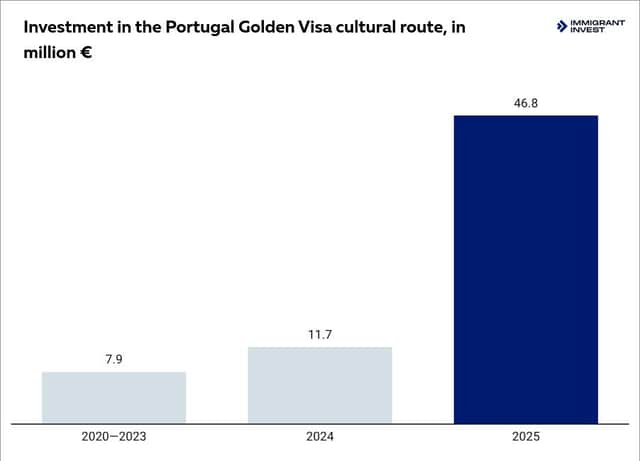
The standard minimum investment is €250,000. Some cultural projects may qualify for a reduced threshold of €200,000 if they are located in designated low-density territories. This makes the cultural route the lowest entry point under the Portugal Golden Visa.
One example of an eligible project is Aventesma, an 8-episode Portuguese-language fiction TV series set in Portugal in 1973—1974 and inspired by the folklore of Portugal’s interior. It shows how a cultural contribution can support a specific production tied to Portuguese history and identity, rather than a vague idea of ‘culture.’
Aventesma is sponsored by Naturtejo, an inter-municipal company in the Beira Baixa region and operator of the Naturtejo UNESCO Global Geopark. The €12 million project has received eligibility approval from GEPAC, Portugal’s Office for Strategy, Planning, and Cultural Assessment. Its donor slots are set at €200,000 because it is located in a low-density area.
Why the cultural donation option is often overlooked
Lower visibility. Many applicants first associate Golden Visas with more familiar routes, such as funds or business-related options. Cultural support does not always come to mind when people think about residence by investment. As a result, some applicants only learn about this route after speaking with advisers.
Unclear qualification. The route can also seem less straightforward because applicants may not know which projects qualify. A fund usually has a structure that investors recognise: documents, managers, strategy, and risk profile. A cultural project may feel less familiar, especially if the applicant has never dealt with cultural institutions in Portugal.
Philanthropic image. The language around the route can create confusion. Words such as culture, heritage, arts, and restoration sound closer to public benefit or charity than immigration planning. This may lead some applicants to assume the contribution has no connection with residence, even though it can be a formal Golden Visa option.
Different expectations. Some investors compare all routes mainly by financial return. The cultural route may not fit that approach. Its value is often strategic and personal rather than purely financial, which means it may be ignored by applicants who only look for a conventional investment product.
Why the cultural donation may appeal to purpose-led investors
Tangible contribution. The cultural route appeals to investors who want their Golden Visa application to support something visible in Portugal. The contribution can help preserve heritage, fund artistic work, or support cultural institutions. This gives the investment a public-interest angle that some applicants find important.
Legacy value. Families may also see this route as a way to connect residence planning with values. Parents may want children to understand that international planning is not only about mobility or wealth protection. It can also involve support for education, history, art, and the country where the family may later spend time.
Personal fit. The route can suit applicants who already feel drawn to Portugal’s culture, architecture, music, literature, or historic towns. For them, the contribution may feel more connected to their reasons for choosing the country. It turns the application from a purely administrative process into a more personal decision.
Long-term thinking. Purpose-led investors may not need every part of their residence strategy to produce direct financial return. They may already have diversified assets elsewhere and see the Golden Visa as a tool for future planning. In this case, cultural support can become part of a wider plan that combines residence, family priorities, and personal values.
What applicants should consider before choosing the cultural donation
Financial expectations. Applicants should understand that the cultural route does not work like a standard investment. The contribution is not designed to generate income or capital growth.
Project checks. Before committing funds, applicants need to confirm that the project qualifies for the Golden Visa. They should also check whether the organisation can provide the necessary documents for the application. This step matters because an unsuitable project can create serious problems for the case.
Compliance documents. The applicant must still prove the legal origin of funds. This may involve evidence of salary, dividends, business income, property sale, inheritance, or other lawful sources. Family members also need documents, and some papers may require translation, legalisation, or apostille.
Realistic timing. The Golden Visa process can take time, even when the investment route is clear. Applicants should plan for document collection, investment confirmation, application submission, review, biometrics, and residence card issuance. The cultural route should be treated as part of a long-term plan, not as an instant residence solution.
Professional guidance. The cultural route is best assessed before any money is transferred. Applicants need to understand the project structure, legal requirements, costs, and risks. Proper guidance helps prevent a simple mistake from delaying or weakening the application.
Final takeaway
Portugal’s cultural investment route gives applicants a different way to look at the Golden Visa. Instead of treating residence planning only as a financial decision, it allows them to support an eligible cultural project and build a more personal connection with Portugal.
The route may suit investors who value legacy, cultural impact, and long-term planning. At the same time, it should be approached carefully: the project must qualify, the donation does not generate a financial return, and applicants still need to meet the formal Golden Visa requirements.
Immigrant Invest can assess whether the cultural route fits your goals, budget, family plans, and timeline.