
Is today a bank holiday in Germany and Poland? Corpus Christi Day explained - which countries celebrate it

Corpus Christi is a public holiday in several countries, including holiday hotspots.
It is a public holiday in countries with a significant Catholic population. These include Austria, Bolivia, Brazil, Croatia, Dominican Republic, East Timor, Equatorial Guinea, Germany (certain regions), Grenada, Haiti, Liechtenstein, Monaco, Poland, Portugal, Saint Lucia, San Marino, Seychelles, Spain, Switzerland, and Trinidad and Tobago.
The holiday's observance is strongly tied to the Catholic Church's celebration of the Eucharist, the body of Christ. While some countries observe it nationwide, others, like Germany and Switzerland, have regional variations in its public holiday status.
In Poland, processions are a major part of the celebration, with children scattering flower petals and homes decorated with religious icons. In Spain and Portugal, it's a widely celebrated festival with elaborate processions.
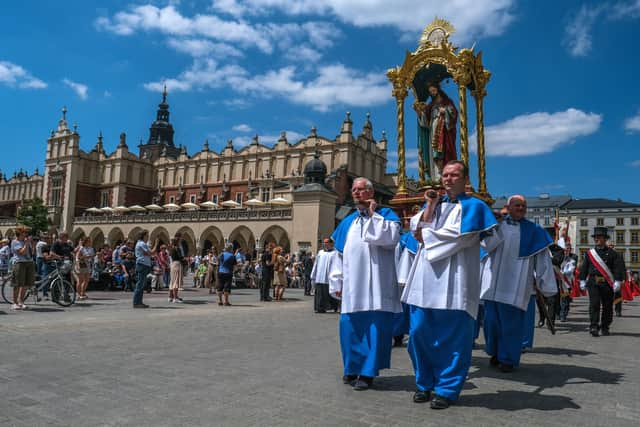

What is Corpus Christi Day?
Corpus Christi, also known as the Solemnity of the Most Holy Body and Blood of Christ, is a Catholic feast day celebrating the Eucharist, the belief that the bread and wine consecrated during Mass become the actual body and blood of Jesus Christ. It's a day to honor and reflect on the real presence of Christ in the Eucharist.
The feast of Corpus Christi will be celebrated on June 19 in 2025. It is observed every year by Christians on the Thursday after Trinity Sunday.
The day is also known as Corpus Domini, which literally translates to ‘body and blood of Christ,’ while some also call it the Feast of Corpus Christi. Unlike other Christian festivals, Corpus Christi is celebrated uniquely in different cultures of the world. The most common way of celebrating the day is by consuming bread and wine — the symbols of the body and blood of Christ.