
Face of man who died on Roman frontier in Scotland 1,900 years ago revealed in striking reconstruction

This article contains affiliate links. We may earn a small commission on items purchased through this article, but that does not affect our editorial judgement.
The face of a man who died on the Roman frontier in Scotland almost 2,000 years ago has been revealed in a striking facial reconstruction.
An international team of experts used scientific techniques to uncover details of the man's appearance, ancestry and life ahead of a major exhibition at the National Museum of Scotland in Edinburgh.
The man is believed to have been in his early 50s when he died at Inveresk, near Edinburgh, between AD 140 and 165. Born in southern Britain, he had travelled hundreds of miles to the shores of the Firth of Forth. Analysis of his skeleton revealed he had suffered several injuries during his life and was unlikely to have been a soldier when he died, as he could not have swung a sword.
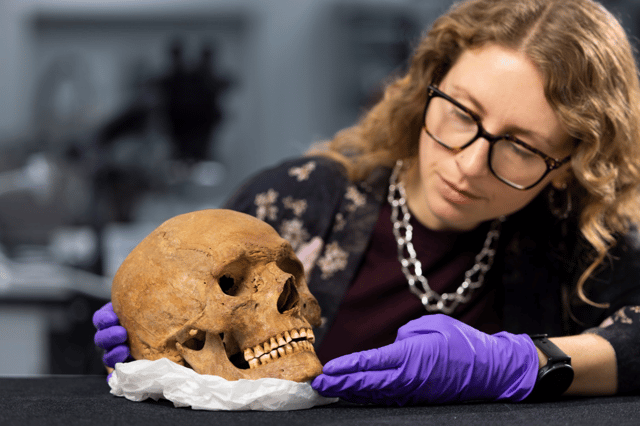
Extensive bone growth around his elbow joint, probably caused by septic arthritis, had severely restricted the use of his right arm. He had also suffered a broken nose that had healed. His skull will go on display alongside the digital reconstruction in Roman Scotland: Life On The Edge Of Empire, which opens on November 14.
Dr Fraser Hunter, principal curator of prehistory and Roman archaeology at National Museums Scotland, said the reconstruction had brought the ancient resident to life. "Archaeology tells us about people who had hopes and fears just like us," he said. "It is a privilege to present a vision of this resident of Inveresk using contemporary scientific techniques."
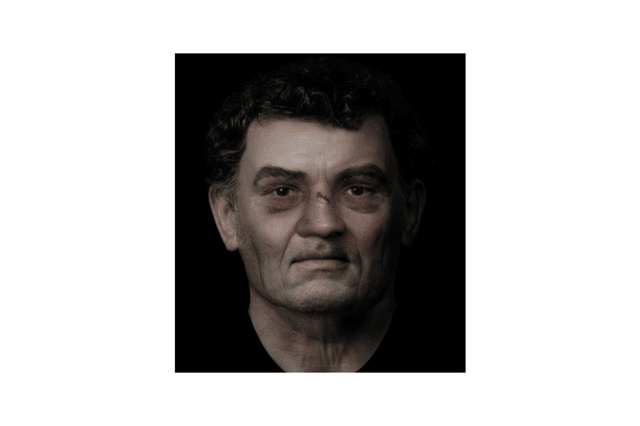
Although his exact appearance cannot be known, Dr Hunter believes his family and friends would have recognised the likeness. The man's burial is among several discovered around the Roman fort at Inveresk, with experts describing the finds as exceptionally rare. Four of the six adult men buried at the site, including the man whose face has been reconstructed, were decapitated after death. The burials are among the earliest known examples of post-mortem decapitation in Britain and the first identified in Scotland.
The reasons for the practice remain unclear, but experts believe it could have been linked to supernatural beliefs, concerns about how the men died or punishment. Dr Jess Thompson, curator of osteoarchaeology at National Museums Scotland, said analysing the remains had helped researchers investigate where the men came from, what brought them to the frontier and what happened to them.
The reconstruction was created by Dr Chris Rynn using findings from skeletal assessments, isotopic analysis led by Durham University scholars and ancient DNA research involving the University of York and Harvard Medical School.
The exhibition will explore life on the edge of the Roman Empire, from soldiers attempting to conquer the land to local communities whose way of life was threatened by the invasion. It runs until April 18, 2027.
🎤✨ Three nights away with live entertainment from £164? Parkdean’s Celebrity Weekenders bring the party this November! 🧳
🕺🎶 Relive your favourite decades with themed breaks spanning 80s hits, 90s nostalgia and boybands vs girlbands!
🏡🏊 Accommodation, entertainment and access to swimming facilities are included, with silent discos and fancy dress adding to the fun! 🎉
🌊⭐ Explore Parkdean’s Celebrity Weekenders across five parks, with prices and line-ups varying by break and availability 📅Click here to find out more