
Solar panel installations soar 407% as UK households brace for higher energy bills
Solar panel installations have risen sharply across Britain as households look for more control over energy costs, with new figures revealing the areas where uptake is highest.
Britain’s appetite for solar panels has soared as households brace for yet another increase in energy bills.
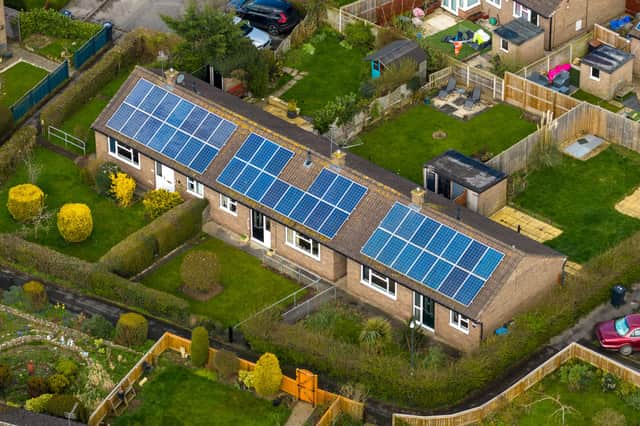

New analysis of MCS-certified Solar PV installation data found annual installs jumped from 53,044 in 2019 to 269,176 in 2025 — a rise of around 407%.
And demand has carried on into 2026, with 191,997 Solar PV installations already recorded between January and August. March was the busiest month so far this year, with 28,853 installations, followed by 28,096 in June.
The figures come after Ofgem confirmed the energy price cap will rise by 4% from 1 October. That takes the typical annual dual-fuel bill from £1,663 to £1,723 for a household paying by direct debit.
Analysis by Glow Green suggests the surge is not just about the energy crisis itself, but also about families wanting more control over future costs.
The data also shows solar uptake is far from even across the UK. Wales, Scotland and rural or semi-rural areas feature heavily among the places with the highest proportion of households with MCS-certified Solar PV installations.
The strongest-performing areas are largely coastal, rural or semi-rural authorities, where homeowners are more likely to have suitable roof space and fewer barriers than people living in flats or densely packed urban areas.
At the top of the list is the Isle of Anglesey, with 4,800 MCS-certified Solar PV installations between 2019 and 2025, equal to 15.58% of households.
At the other end of the scale, uptake remains lowest in parts of inner London. Kensington and Chelsea recorded 170 installations over the same period, equal to 0.25% of households, while Tower Hamlets recorded 350, or 0.29% of households. Hammersmith and Fulham and Westminster also appeared among the lowest-uptake areas.
In 2026 so far, Neath Port Talbot has recorded the strongest household uptake, followed by East Cambridgeshire, Na h-Eileanan Siar and Isle of Anglesey.
Lloyd Greenfield, CEO of Glow Green, said: “The latest energy price cap announcement is a reminder that household energy costs are still being shaped by forces well beyond the control of individual consumers. Even though prices are below the peak of the energy crisis, many households are still facing uncertainty over what they will pay from one winter to the next.
“That uncertainty is one of the reasons solar has moved from being seen as a purely environmental upgrade to a much more practical household decision. More homeowners are looking at solar because they want greater control over their energy use and more protection from future bill shocks.
“What is particularly notable is that demand has continued beyond the immediate peak of the energy crisis. That suggests many households are not only reacting to short-term price rises, but are also thinking more carefully about energy security, long-term running costs and how resilient their homes are to future changes in the market.
“With bills rising again from October, we expect more households to look seriously at what they can do to reduce their exposure to future price changes. Solar will not be right for every property, but for suitable homes it can be one of the most effective ways to make energy costs more predictable over time.”
For households thinking about going solar, the first checks are practical ones: whether the roof has enough suitable space, how much shade it gets during the day, and whether the household uses enough electricity while the panels are generating power.
A proper home assessment is also important, as projected savings can vary significantly depending on the property, the system size and how much generated electricity is used in the home rather than exported back to the grid.