
What is a sonic boom? RAF Typhoon jet makes loud bang noise, was there an explosion in UK today - what happened

A sonic boom was heard across large parts of the UK.
The 'bang' was so loud it reportedly led to people going outside to see what had happened at about 11.45am today (Friday, August 15). It was heard in ares such as Chelmsford and southern parts of Essex.
Some even thought there was an explosion. It is thought that the sonic boom sound could possibly have been caused by a Royal Air Force (RAF) Eurofighter Typhoon FGR4 aircraft which has been spotted on flight radars travelling in the area at the time.
Javelin Sam (@javelinsam) on X posted at 11.46am: "Sonic boom just heard over Hornchurch. Eurofighter Typhoon FGR4 went overhead."
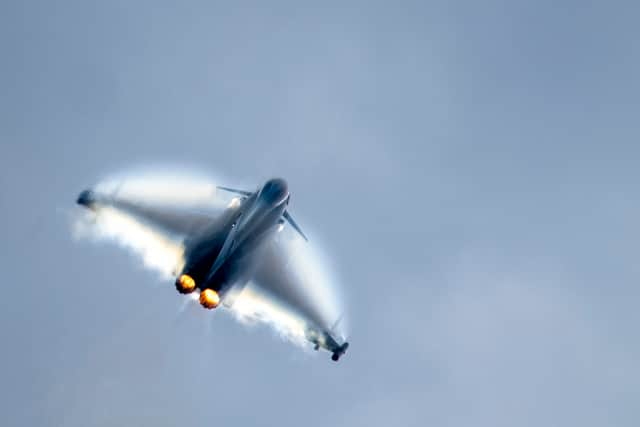

According to aviation fanatics on X the loud noise was heard due to a British Typhoon fighter jet escorting a private jet to London Stansted Airport. Tracking on FlightRadar shows a Royal Air Force Typhoon flying around the Stansted Airport area. One user wrote: “Bombardier Global Express XRS en route from Nice to London Stansted escorted by a Eurofighter Typhoon FGR4 into Stansted Airport.
“Many people on social media reported hearing a sonic boom from the fighter jet as it raced to intercept the aircraft.” It is not known at this time why the Typhoon was escorting the private jet.
What is a sonic boom?
A sonic boom is the sound associated with the speed of sound being broken. Shock waves are created when an object, in this case the fighter jets, travels through the air faster than sound.
This creates an enormous amount of sound energy. To the human ear it sounds like an explosion or a thunderclap. Due to the size of the aircraft this can be particularly loud and startling. As a result of the impact aircrafts are prohibited from supersonic flight over land normally.
On top of the initial sound, the boom continues while the object in question is travelling at supersonic speeds. But this will not be constantly heard by the human ear - it only affects observers positioned at a point that intersects a region in the shape of a geometrical cone behind the object.
As the object moves, this conical region also moves behind it and when the cone passes over the observer, they will briefly experience the boom.