
Do all countries change their clocks? Did they go back today in UK, is it the same in Spain, France - why do we change the clocks

The clocks have gone backwards this weekend - does this happen in other countries too?
The switch marks the end of British Summer Time (BST) and the beginning of Greenwich Mean Time (GMT) in the UK. The clocks went back last night (Saturday 25 October).
The clocks will go back by an hour at 2am. Greenwich Mean Time (GMT) always starts at 2am on the last Sunday in October.
Most electronic devices like smartphones will automatically roll back an hour, but some, like ovens, may not and you may have to manually change them. GMT will last until March 29 – the last Sunday that month – when the clocks go forward by one hour and we lose an hour in bed.
The man behind daylight savings is widely credited as Benjamin Franklin, convinced he was wasting his time in bed while living in Paris in the 18th century. The idea of losing and gaining an hour each year took a while to catch on across the pond.
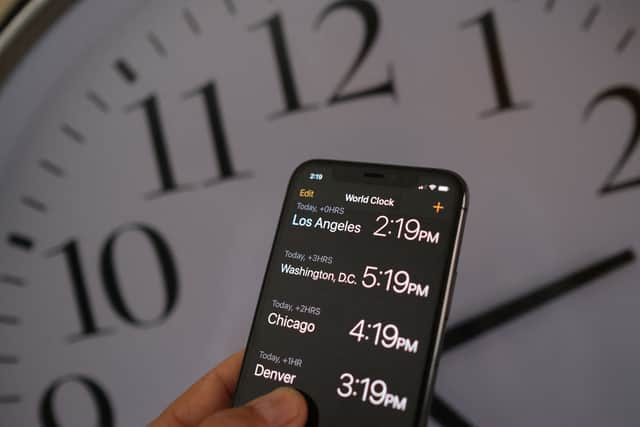

In the 1700s, Brits set their clocks according to the sun, creating dozens of conflicting local times depending on where in the country you were. So for a time places in the far west of England were about 20 minutes ‘behind’ London.
You’d board a train heading north and basically have to reset your watch every 10 miles as you travelled across these different ‘time zones’. It was only in the 1840s that we in the UK first adopted standard times after the Great Western Railway introduced ‘railway time’ – a consistent time dictated by the Royal Observatory at Greenwich.
British builder William Willett, Coldplay singer Chris Martin’s great-great-grandfather, angry at the ‘waste of daylight’ during summer mornings, put the idea forward in 1907. It was adopted in 1916 during the First World War.
Clocks-changing isn’t just a UK thing – more than 70 countries around the globe do it. Most European countries observe European summertime (Daylight Saving) – changing their clocks at the end of March and again at the end of October.
The only European countries that don’t are Iceland, Turkey, Belarus and Russia. Neither do nearby Armenia, Azerbaijan and Georgia. Meanwhile, the United States, Canada, Australia and New Zealand observe Daylight Saving.
Most Asian countries, including India, Japan, China and Mongolia, opt not to use Daylight Saving Time, while many Middle Eastern countries also avoid changing their clocks. For some, such as Iran and Jordan, dropping DST is a fairly recent change, while Egypt decided to restore it in 2023. In Africa, most countries do not use it. Morocco does, as do the nearby Canary Islands, which are part of Spain.