
Euro 2024 final: What to expect from Spain including results, coach, key players including Man City ace and ex-Chelsea man

England are aiming to win their first major trophy since 1966 on Sunday.
Gareth Southgate’s England team are just one game away from footballing immortality after reaching their first ever major final on foreign soil.

The Three Lions roared to victory with their best performance of the tournament so far in the semi-finals against Netherlands as substitute Ollie Watkins stepped up from the bench to score from a tight angle in the final moments of the game after an excellent through ball from fellow substitute Cole Palmer.
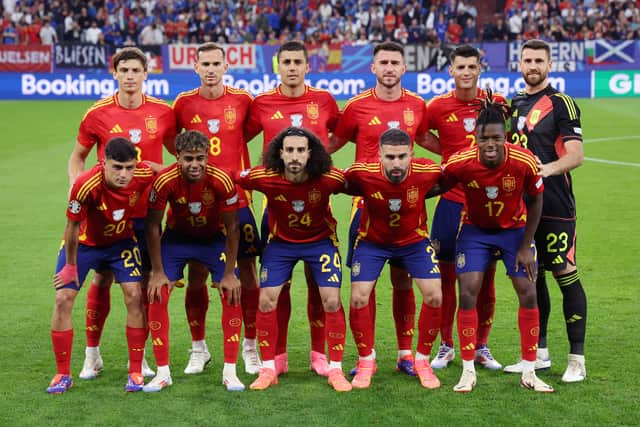
The victory at Dortmund’s Signal Iduna Park sets up a blockbuster final with three-time winners Spain, who themselves have the chance to become the most successful team in European Championships history with a victory at the Olympiastadion in Berlin.
This year’s final marks one of the most important matches in England’s history as the Three Lions look to end a 58 year hiatus without a major trophy. But what can Southgate and his team expect from Spain in this year’s final - and who are the main players that the team need to watch out for?
Spain’s road to the Euro 2024 final
Spain were drawn in Group B alongside holders Italy, World Cup semi-finalists Croatia and Albania. Many experts considered this to be the toughest group in the entire competition, but Spain showed no signs of nerves in their opening game and secured a comfortable 3-0 victory over Croatia after goals from Alvaro Morata, Fabian Ruiz and Dani Carvajal.
Luis da la Fuente’s side proved to be tough to break down and continued their fine form with back-to-back 1-0 victories over Italy and Albania to top the group without conceding a single goal.
This victory left Spain with a potential banana skin against tournament debutants Georgia, who entered the game on a high after a shock 2-0 victory over Portugal. The underdogs started the game better and took a shock lead through Robin Le Normand's own goal. However, Spain were unaffected by the setback and went on to punish Georgia with a ruthless attacking display in the second half as they ran out 4-1 winners.
Despite winning every game, Spain found themselves on the tougher side of the draw and needed to show a different side to their game when they came head-to-head with a spirited Germany team in a tightly-fought 2-1 victory after a dramatic 119th winner from substitute Mikel Merino. At times, Spain were forced to be more direct and aggressive in their play and also proved their defensive solidity by soaking up pressure from the hosts.
This victory set up a semi-final with pre-tournament favourites France, where they were once again forced to battle their way back from behind after a goal from Randal Kolo Muani.
A 21st minute screamer from 16-year-old Lamine Yamal brought Spain back into the game and the match was decided just four minutes later when Dani Olmo made his mark with a strike from close range.
Spain are now aiming to become the first side in Euros history to win all seven games without drawing or needing a penalty shoot-out at some stage in the competition. Only Brazil during the 2002 World Cup have previously achieved the feat although their road to the final was much less strenuous than the one La Roja have had to navigate.
Where are Spain in the FIFA World Rankings?
Despite winning two European Championships (2008 and 2012) , the World Cup (2010) and most recently the UEFA Nations League (2023) Spain are surprisingly only ranked 10th in the FIFA World Rankings.
This makes them the eighth best team in European football, according to FIFA.
Who is the Spain manager?
Spain are managed by former Athletic Bilbao and Sevilla footballer Luis de la Fuente.
The 63-year-old never represented his country at international level during his playing days but spent the majority of his career playing left back in Spain’s top division. He retired from football in 1994 and is current working in his first senior management role since 2011.
De la Fuente has spent most of his career in coaching working in youth football other than brief spells in the lower Spanish league’s with Club Portugalete and CD Aurrerá de Vitoria. After achieving success with Sevilla and Athletic Bilbao’s youth teams he had a brief stint as manager of Alaves in the second division but was dismissed after just 11 games.
The experienced coach took a two year break from football before becoming Spain’s U19 boss in 2013. He guided the U19s to Euro glory in 2015 before also lifting the same trophy with the U21s in 2019. He also lifted a silver medal with the Spanish team at the Olympics in 2020 before inheriting the national team job from Luis Enrique after La Roja’s penalty shoot-out defeat to Morocco at the 2022 World Cup.
Since his appointment he has won 16 of his 20 games at the helm, drawing twice and losing twice. In that time, he has also guided his nation to their first ever UEFA Nations League triumph and ushered in a new era of young talent.
Who are the key players for Spain?
Spain are blessed with an abundance of talent in all areas of the pitch but the catalyst for most of their dominance comes from defensive midfielder Rodri.
The Manchester City man plays a very similar role to one Sergio Busquets played for Barcelona and the great Spanish team of the past. He operates in the defensive midfield role and is tasked with protecting the centre of the pitch through breaking up play and interceptions whilst also being the starting point for many of the team’s attack with his incisive passing.
Rodri has a win record of 74.4% in a Manchester City shirt (StatMuse) making them a significantly more difficult team to face and break down with him in the side.
Ahead of Rodri, much of the creativity comes from PSG’s Fabian Ruiz and RB Leipzig’s Dani Olmo - they have registered a combined five goals and four assists between them at this tournament which is even more impressive considering that Pedri was the first choice starter before his injury.
Unlike Spain's team of the past which played an entirely possession based system. This Spain team is also known for mixing it up with explosive counter attacks from out wide. These mainly come through the form of 16-year-old Barcelona sensation Lamine Yamal as well as Athletic Bilbao youngster Nico Williams. Both are known for their ability to run at defenders with speed, take players on and stretch defences.
The pair are often unselfishly supported by a more physical central threat in former Chelsea man Alvaro Morata. The 31-year-old, who was criticised during his 18 month stint at Stamford Bridge after scoring 16 times in 47 matches, is known for his ability to draw out defences with his unselfish runs and hold up play, but is also capable of scoring goals himself with a total of 36 goals in 79 caps - making him the fourth highest goalscorer in Spain’s history.
Spain typically play a 433 formation and are known for taking risks and pressing high and aggressively to try and force the opposition into mistakes, which has so far made them one of the most entertaining teams in the tournament.