
British trio accused of smuggling cocaine facing capital punishment in Indonesia, what is death by firing squad

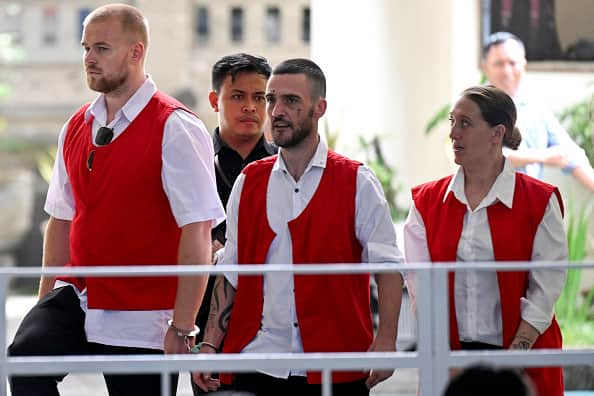
Three British nationals are facing the death penalty in Indonesia after being accused of smuggling over two pounds of cocaine into the country.
Jonathan Christopher Collyer, 28, and Lisa Ellen Stocker, 29, were arrested on February 1 at Bali’s I Gusti Ngurah Rai International Airport. Prosecutors told a district court in Denpasar this week that customs officers discovered 993.56 grams (2.19 pounds) of cocaine concealed in packets of Angel Delight dessert mix inside the pair's luggage.
The drugs, reportedly worth 6 billion rupiah (£272,000), were found during a routine inspection. A third British national, 31-year-old Phineas Ambrose Float, was arrested two days later after Collyer and Stocker allegedly handed over the drugs to him in a controlled delivery operation organised by Indonesian police. Authorities say the trio had successfully smuggled cocaine into the country on two previous occasions.
All three could face capital punishment under Indonesia’s tough narcotics legislation. The panel of judges has adjourned the trial to 10 June to hear witness testimony. The suspects have so far declined to comment.
Indonesia enforces some of the harshest drug laws in the world. Trafficking offences can lead to life imprisonment or execution by firing squad, a fate that has befallen both locals and foreigners. The country’s most recent executions took place in 2016, when an Indonesian and three foreign nationals were put to death.

Currently, more than 530 people, including 96 foreign nationals, are on death row in Indonesia, most for drug offences, according to the Ministry of Immigration and Corrections.
Among the most well-known cases is that of Lindsay Sandiford, a British grandmother who has spent more than a decade on death row after she was convicted of smuggling 3.8 kilograms of cocaine into Bali in 2012. Her death sentence was upheld in 2013, and she remains incarcerated in Kerobokan Prison awaiting execution.
Similarly, Australian national Schapelle Corby was sentenced to 20 years in prison in 2005 for smuggling 4.2 kilograms of marijuana into Bali. Although not sentenced to death, her case attracted global media attention and debate over Indonesia's zero-tolerance approach. She was granted parole in 2014 and deported in 2017.
According to the United Nations Office on Drugs and Crime, Indonesia remains a major transit point for international drug trafficking networks. Its strict penalties, authorities argue, are meant to deter drug syndicates that often target the country’s large and youthful population.
But human rights groups continue to criticise Indonesia’s use of the death penalty, especially in cases involving foreign nationals, arguing that it undermines the principles of fair trial and rehabilitation.
What is death by firing squad?
In Indonesia, executions for drug trafficking are typically carried out by firing squad, a method widely regarded as one of the harshest and most controversial still in use today.
The prisoner is blindfolded and either tied to a post or seated in a chair, then faced by a firing squad of 12 police officers. To preserve anonymity, only three rifles are loaded with live ammunition, while the remaining nine carry blanks, so no one knows who fired the fatal shots.
If the prisoner is still alive after the first round, the commander is required to deliver a final shot to the head. This method is standard for all death row executions in Indonesia, including those for drug-related crimes, terrorism, and premeditated murder.