
Los Angeles fire containment: Crews struggle to control fires as more erupt - how are they trying to contain the blazes?

Fire crews are struggling to contain wildfires in California as more continue to erupt - causing LA to turn into a real-life apocalypse film.
Tuesday (7 January) brought one of most devastating days in the city's history. The Pacific Palisades Fire started around 10:30 local time. Stoked by ferocious winds, the fire quickly spread, soon engulfing more than 3,000 acres in that upscale community.
The Palisades Fire is now more than 15,000 acres, while the Eaton Fire has scorched some 10,600 acres. The fires have forced the evacuation of tens of thousands of residents, including more than 60,000 in the Pacific Palisades neighbourhood. More than 450,000 people are without power throughout the region, according to PowerOutage.us.
A new, sixth, blaze erupted in Hollywood Hills on Wednesday night (8 January), prompting even more evacuation orders in the area. Homes have been destroyed across the LA area, including those owned by several celebrities. Diane Warren, Anna Faris, and Adam Brody and his wife Leighton Meester are among the many celebrities to have reportedly lost their homes in the wildfires still burning across Los Angeles.
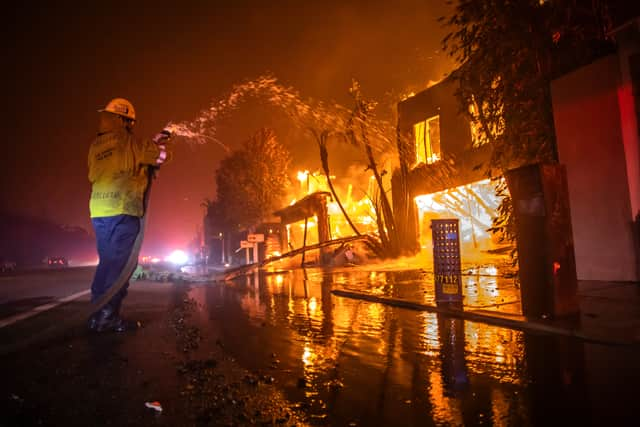

How are firefighters trying to contain the blazes?
Once it's started, a wildfire can spread due to the wind. Fire experts use wildfire prediction tools which look at the wind speeds, slopes, the fire's direction and fuel to work out how to put out the blaze.
Fire hydrants have been used to fight the fires. About 20% of hydrants used to fight the Palisades Fire went dry on Wednesday, city Department of Water and Power CEO Janisse Quiñones acknowledged during a news conference. Mobile water tankers are now supplementing the supply, Hudson said.
On Wednesday 20 tankers with water were being sent to support firefighters in the Palisades, and the tankers were having to reload at other distant locations. Containment of a wildfire involves getting out ahead of the fire, cutting a firebreak down to bare dirt in a wide enough patch that the fire can't cross, and letting it putter out. But in the wilderness, just getting to where the fire is can be hard.
The fire may be burning along the side of a steep mountain that requires firefighters to climb thousands of feet. Firefighters have to encircle the fires fully, which could mean massive perimeters of hundreds of miles, where they have to quickly clear the area, drench the soil and vegetation with as much water and flame retardants as possible.