
What is the San Andreas fault? What plate boundary is it, is it active, when is it going to happen - as earthquakes hit California

A series of earthquakes have hit California - with seismic activity is more frequent there due to the state’s extensive fault system, which includes the well-known San Andreas Fault.
California is situated near the border of two major tectonic plates, the Pacific Plate and the North American Plate, which are continually moving and grinding against one another. This means earthquakes frequently occur there.
This ongoing movement builds up stress in the Earth’s crust, which is released as earthquakes when the pressure becomes too great. About two-thirds of the motion between the two plates is caused by the San Andreas Fault alone, which also frequently causes large earthquakes.
The San Andreas Fault is California’s longest and best-know fault, running from the Salton Sea in Southern California to off the coast of Mendocino in Northern California. It extends for approximately 746 miles (1,200 kilometers) and is split into three sections.
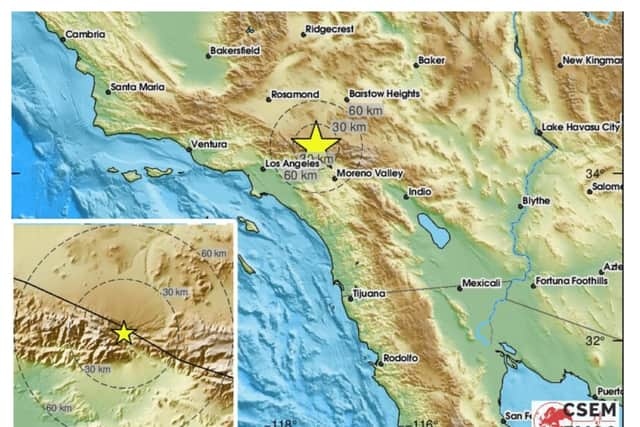

The northern segment stretches from Cape Mendocino to Hollister and includes the area around the San Francisco Bay. The central segment runs from Hollister to Parkfield and is characterized by a phenomenon called aseismic creep, where the fault slips continuously without causing earthquakes. There has never been a large earthquake on this section in recorded history.
The southern segment extends from Parkfield to the Salton Sea. It is a significant threat to highly-populated areas like Los Angeles. Geologists estimate that the southern San Andreas could produce a quake of up to magnitude 8.3.
As far as they know, the fault hasn't ever produced a quake larger than the 1857 or 1906 quakes, both of which were probably around magnitude 7.9. If a magnitude 7.8 quake were to hit the southern San Andreas, geologists expect it would cause 1,800 deaths, 50,000 injuries and $200 billion in damage.
Scientists can't predict when the next San Andreas earthquake — or any earthquake — will occur. But they can get an idea of the future risk by looking at how often earthquakes have occurred in the past.
On the southern San Andreas, some sections seem to give off a good shake every 100 years or so, while others go as long as 300 years between major quakes. The U.S. Geological Survey has calculated that there's a 72% chance of a magnitude 6.7 earthquake in the San Francisco Bay region by 2043. And there's a 60% chance of a quake of 6.7 or larger in that time frame in the Los Angeles region.