
Philippines earthquake tsunami warning: “Doublet quake” kills at least seven and sets off landslides

Two powerful earthquakes have struck the Philippines within hours leaving at least seven people dead.
A tsunami warning prompted the evacuation of coastal areas after a ‘double quake’ in the Philippines. After a 7.4 magnitude earthquake hit the southern region on Friday morning, it was followed by a second, offshore quake preliminary ranking as a 6.9 magnitude nearby, seismologists said.
Reports said at least seven people died in the morning quake, which led to landslides and damage to hospitals and schools, as well as prompting evacuations in coastal areas due to a tsunami warning which was later lifted.
Teresito Bacolcol, chief of the Philippine Institute of Seismology and Volcanology, said Friday’s second earthquake, that jolted Manay town in Davao Oriental province, was caused by movement in the same fault line as the first - the Philippine Trench - at a depth of 10 kilometres (six miles).
“The second one is a separate earthquake, which we call a doublet quake,” Mr Bacolcol told The Associated Press. “Both happened in the same area but have different strengths and epicentres.”
President Ferdinand Marcos Jr, facing his latest natural disaster after a recent deadly earthquake and back-to-back storms, said the damage was being assessed and rescue teams and relief operations would be deployed when it was safe to do so.
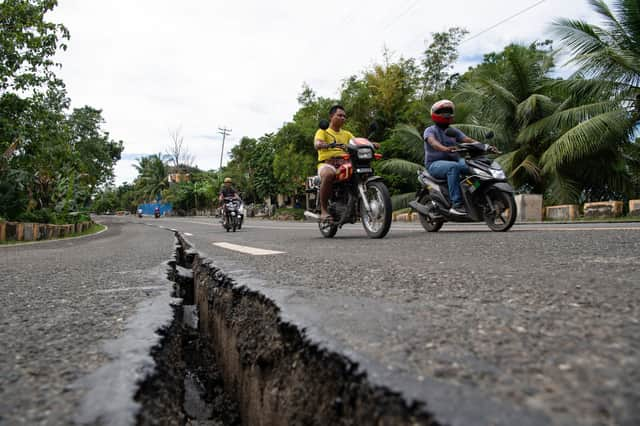

The Philippine Institute of Volcanology and Seismology said it had been expecting damage and aftershocks from the quake, which was centred at sea about 43 kilometres (27 miles) east of Manay town, in Davao Oriental province.
Of the seven people confirmed to have been killed, two were hospital patients who died of heart attacks, while another was a resident hit by debris in Mati city, according to Ednar Dayanghirang, regional director of the government’s Office of Civil Defence.
Elsewhere, three villagers died and several others were rescued with injuries by army troops and civilian volunteers after the quake sparked a landslide in a remote gold-mining village in Pantukan town in Davao de Oro province near Davao Oriental.
Another resident died because of the first quake in the port city of Davao, disaster mitigation officials said without providing other details, adding a few hundred residents were injured in the city.
Bernardo Rafaelito Alejandro IV, deputy administrator at the Office of Civil Defence, said several buildings sustained cracks in their walls, including an international airport in Davao city, but it remained operational without any flights being cancelled.
“I was driving my car when it suddenly swayed and I saw power lines swaying wildly. People darted out of houses and buildings as the ground shook and electricity came off,” Jun Saavedra, a disaster mitigation officer of Governor Generoso town in Davao Oriental, told The Associated Press. “We’ve had earthquakes in the past, but this was the strongest.”
He said the intense ground swaying caused cracks in several buildings, including a high school, where about 50 students were brought to a hospital by ambulance after sustaining bruises or fainting because of the quake.
Governor Generoso is a town about 100 kilometres (62 miles) south of Manay, where school classes in all levels were also suspended.
Schools in Davao city, which has about 5.4 million people and is the biggest city near the epicentre, were also evacuated, despite being around 250 kilometres (155 miles) west of Davao Oriental province.
Following the quake, the Pacific Tsunami Warning Centre in Honolulu said small waves were detected on the coasts of the Philippines and Indonesia before the threat passed about two hours later - but warned small sea fluctuations may continue.
Following the tsunami warning, six coastal provinces near Davao Oriental were evacuated, before people were allowed to return, chief government seismologist Teresito Bacolcol said.
Indonesia’s Meteorology, Climatology and Geophysics Agency said small tsunami waves were detected in North Sulawesi province with heights ranging from 3.5 to 17cm (1.3 to 6.7 inches) in Melonguane, Beo, Essang and Ganalo in Talaud Islands districts.
The quakes came after the Philippines was hit by a 6.9 magnitude incident on September 30, which claimed the lives of at least 74 people and displaced thousands more in the central province of Cebu.
Meanwhile, also on Friday, an earthquake with a preliminary magnitude of 6.0 struck off the coast of Papua New Guinea. The US Geological Survey said that it was centred in the Bismarck Sea 414 kilometres (257 miles) northeast of Lae, the South Pacific island nation’s second-most populous city.
Lae police official Mary Jane Huafilong said no damage was reported.